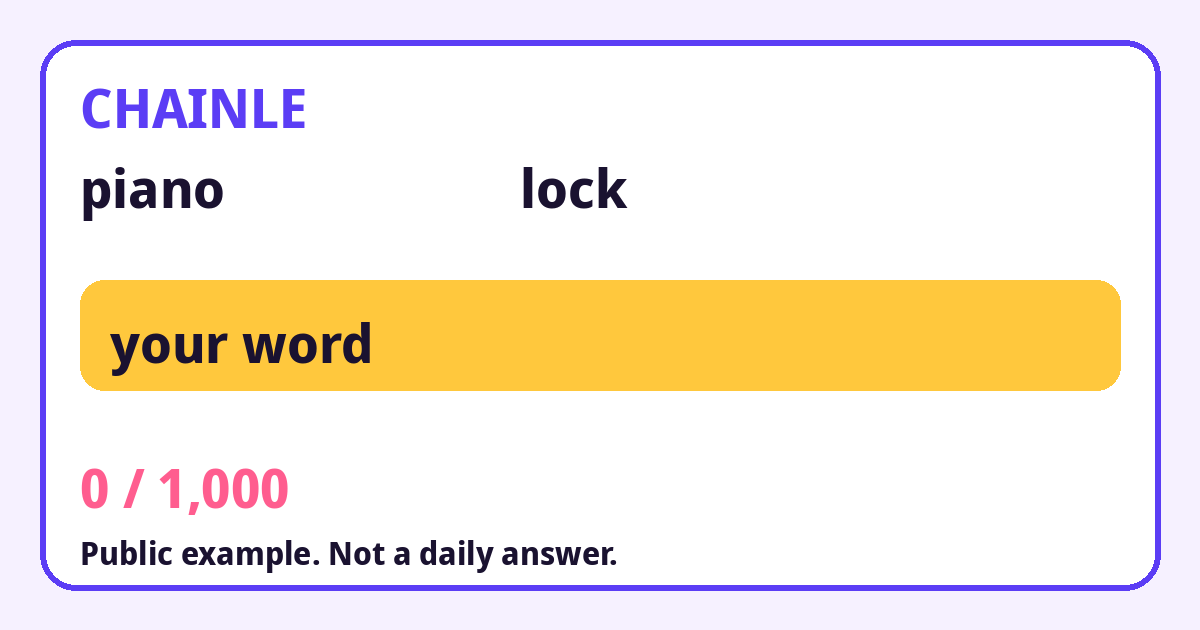
How to play a Chainle round
How to play Chainle starts with the shape of the day. Rounds 1 to 3 take two clues, round 4 takes three, and round 5 is a closest connection. Open the home page and play those five in order. The first input accepts a word immediately. Each later input opens after the one before it has a score. Nothing on the board is racing you.
- Read the clues. Each round shows one, two, or three English clues. The clues are the whole prompt. You do not uncover extra tiles.
- Think of one connecting word. On a bridge round the word should meet every clue. On the closest-connection round it should be a near synonym of the single clue.
- Type a single English word. One submission per round. Use letters only. A phrase, a clue copied from the board, or a string outside the Google 10,000 English words list and the short extra classroom list does not spend the round.
- Submit and read the score. A listed connection scores the number written beside it, up to 1,000. Another recognized word is scored by how close it is in meaning to the clues, so a near miss still earns points. The strongest listed word is not printed on the daily board.
- Finish five rounds. The day is complete at five scores. Copy the share card if you want to compare totals. The card has no clues and no answers.
When you want the numbered rules beside a live board, go back and play Chainle. The examples below are classroom puzzles. They are not today's daily set, and they are not drawn from any other site's puzzle list. If you would rather drill the shape than read about it, open Chainle Unlimited and submit as many practice rounds as you like. Practice never writes a daily score.
How to play Chainle with two clues
On a two-word bridge, find one word that meets two clues at once. The useful test is spoken, not clever. Put your guess next to each clue and ask whether a fluent speaker would accept the pair. "Piano key" and "keyboard key" are both ordinary. That is why the classroom gold below is key. A word that only fits the piano, such as pedal, is still a real English word, but it is not a listed alternative, so the scorer places it by meaning. Button is listed at 420 because it fits a desk keyboard much better than a piano. Note is listed at 700 because a piano note is a real musical object, while a keyboard note is a looser idea.
Example 1: piano + keyboard
Clues: piano, keyboard. Strongest listed connection: key. Accepted alternatives: button (420), note (700).
A piano sounds when its keys are pressed. A keyboard, on a desk or on an instrument, is a row of keys.
Example 2: library + river
Clues: library, river. Strongest listed connection: branch. Accepted alternatives: wing (520), fork (640).
A library branch is a smaller site that belongs to the same library. A river branch is a fork that leaves the main stream.
It gets easier once you have heard one bridge out loud. Say the two clues, then say the word you mean, and notice whether a person who has never seen this page would accept both phrases. If one phrase sounds made up for the puzzle, keep looking. The library and river example is the same shape with a different kind of double meaning. Branch is a site of a library and a fork of a river. Wing fits the library building and misses the water. Fork fits the river and is a stretch for a library. Those lower scores mean the link is real but narrower. They are not a punishment for guessing, and they are not a hint about today's daily clues.
How to play Chainle with three clues
The three-word bridge is still one word, and now every clue has to accept it. Round 4 adds a third clue. Players lose points here by solving the first pair too quickly. Snow and bed suggest blanket, sheet, or cover. Book then asks which of those words also belongs to a book. Cover does. Sheet fits a bed and is weaker for a book, so it is listed at 640. Jacket fits a book more than it fits snow, so it is listed at 560. A word we did not list is still scored by meaning. The explanation shows the standard used for this classroom set.
Example 3: snow + bed + book
Clues: snow, bed, book. Strongest listed connection: cover. Accepted alternatives: sheet (640), jacket (560).
Snow cover, a bed cover, and a book cover all name a layer over something else. The word has to meet the weather, the furniture, and the book, not just the easiest of the three.
How to play the Chainle closest connection
Round 5 has a single clue. You are looking for the nearest ordinary synonym, not a rhyme and not a word from the same topic. Vivid points to bright. Brilliant is close enough to list at 840, because it can mean intensely bright and also intellectually bright. Colorful is listed at 720 because it names the presence of color more than the force of the image. A word from a different sense of a similar spelling would not inherit this score. The scoring page describes that limit with the same classroom example.
Example 4: vivid
Clue: vivid. Strongest listed connection: bright. Accepted alternatives: brilliant (840), colorful (720).
Bright is the plain synonym of vivid. Brilliant can mean intensely bright, and colorful names the presence of color more than the strength of it.
Playing Chainle: scoring each answer
Four bands, read from the final points: 900–1,000, 600–899, 300–599, and below 300. A listed alternative keeps the preset written beside it, from 200 to 980, even when the meaning score is lower. The scoring page is the full account, including round 5.
What does not use up your Chainle guess
Submit nothing and the round stays open. Submit "piano" on the piano-and-keyboard example and the round stays open, because repeating a clue is not a connection. Submit a mash of letters that is not recognized and the round stays open. Simple plurals still meet a listed singular. A recognized word does spend the round, and it is scored by how close it is in meaning to the clues.
Recognized words come from the Google 10,000 English words list, no-swears edition, from the Google Web Trillion Word Corpus, with British spellings left out, plus a short extra list of classroom words that list missed.
What you see after you play a Chainle word
After you submit a real word, the board draws a chain from each clue toward your guess, one link at a time, then counts the round score up from zero. A tight chain is a high score. Five rounds end in a results popup: each round's score, the day total out of 5,000, how many rounds locked at the top, your streak, and a countdown to the next 00:00 UTC puzzle. You can copy a share result from that popup. It has colors and a total, not clues or answers. The same popup is there when you come back to a finished day. It never prints today's listed connections.
Chainle time, streaks, and practice
There is no shot clock and no bonus for speed. The only clock on the home page counts down to 00:00 UTC. Finish today's five rounds and the streak on this device moves forward by one if yesterday was finished or if this is your first finish. Finish them again and the streak does not move a second time. Play an older date from the archive and the streak does not move at all. The Chainle FAQ answers the storage questions, including the exact local-storage keys and the fact that a new browser starts at zero.
Three mistakes when you play Chainle
People type a phrase instead of one word. People type the easier clue's partner and ignore the second clue. People treat the last clue as a topic instead of a synonym. When one of those shows up, fix the entry and play again if the input is still open.